


Before Air Force One landed, AI memes of Trump, Musk, and Huang were already filling Chinese social media. Clips from the Temple of Heaven visit and the state dinner went viral last night.It’s the first US presidential visit to Beijing in nearly nine years. Trump brought a trillion-dollar business delegation to Beijing, heavier on tech and finance than any US-China summit in a decade. Both sides have stopped trying to reintegrate. This summit is the first formal attempt to set the terms for two decoupled economies that still depend on each other.
Trump’s Beijing Delegation Skipped Energy and Added Jensen Huang at the Last Minute
Trump landed in Beijing on Wednesday evening with 17 American CEOs. Eight of them, 47%, came from tech and semiconductors. Six came from Wall Street. Energy, which made up 48% of his 2017 delegation, contributed zero. Agriculture sent one. Jensen Huang was not on the White House’s May 11 list. Reuters photographers caught him boarding Air Force One when the plane refueled in Alaska. Nvidia’s share of Chinese AI accelerators ran 95% in 2022. By September 2025, Huang said on the record it had collapsed to “close to zero.”
The localization push has balance sheets and stock charts behind it. Cambricon’s market cap is around RMB 800 billion (about $110 billion). DeepSeek’s most recent funding round included Chinese state capital, locking the company into a domestic-chip-heavy procurement path. ByteDance just guided up its CapEx and said new spending would skew toward Chinese compute. On May 14, the first day of Trump’s Beijing summit, Reuters reported that the US has cleared roughly 10 Chinese firms, including Alibaba, Tencent, ByteDance, and JD.com, to buy Nvidia’s H200, each licensed for up to 75,000 chips with a 25% revenue cut going to Washington. No chips have been delivered yet.
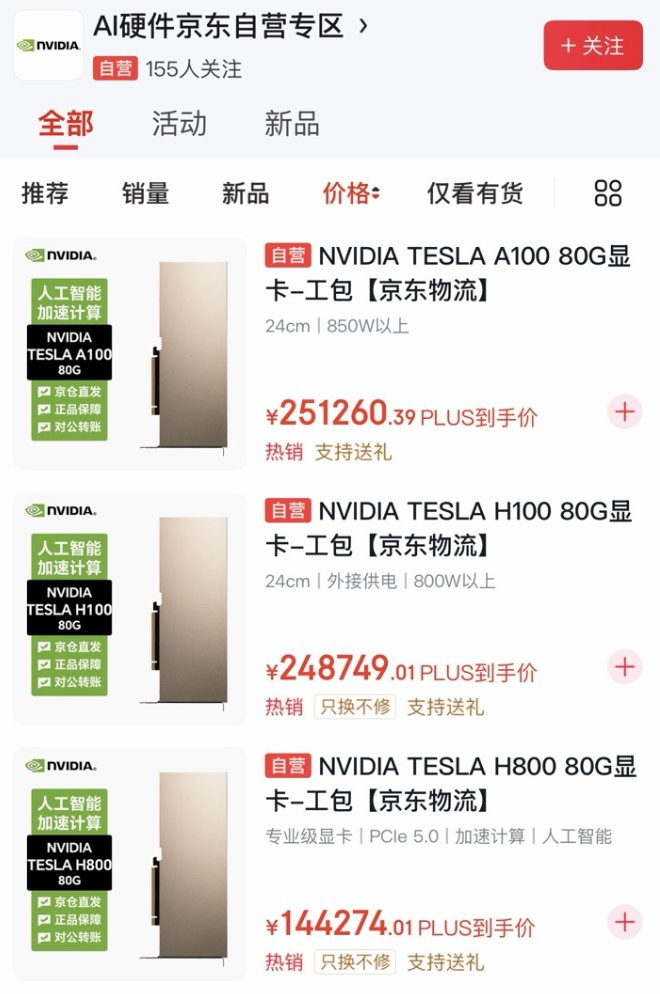
Within hours of the Reuters report, sellers on Chinese e-commerce platform JD.com listed Nvidia’s H100, A100, and H800 chips overnight between May 14 and 15. The listings were pulled by morning and some storefronts were suspended, with no clear public reason. JD.com is itself one of the 10 firms cleared under the H200 program.
Hong Kong’s AI Frame Makes Kuaishou’s $20 Billion Kling Spin-Off Look Like a Discount
Kuaishou plans to spin off its Kling AI video unit at a $20 billion valuation and raise $2 billion. Kling’s annualized revenue is at $500 million now, and management expects it to reach $1.3 billion when the IPO process opens in Q1 2027. The implied multiple on current ARR is 40x.
Kling AI-generated clip of a Korean-style baseball stadium crowd, viral on Chinese social media.
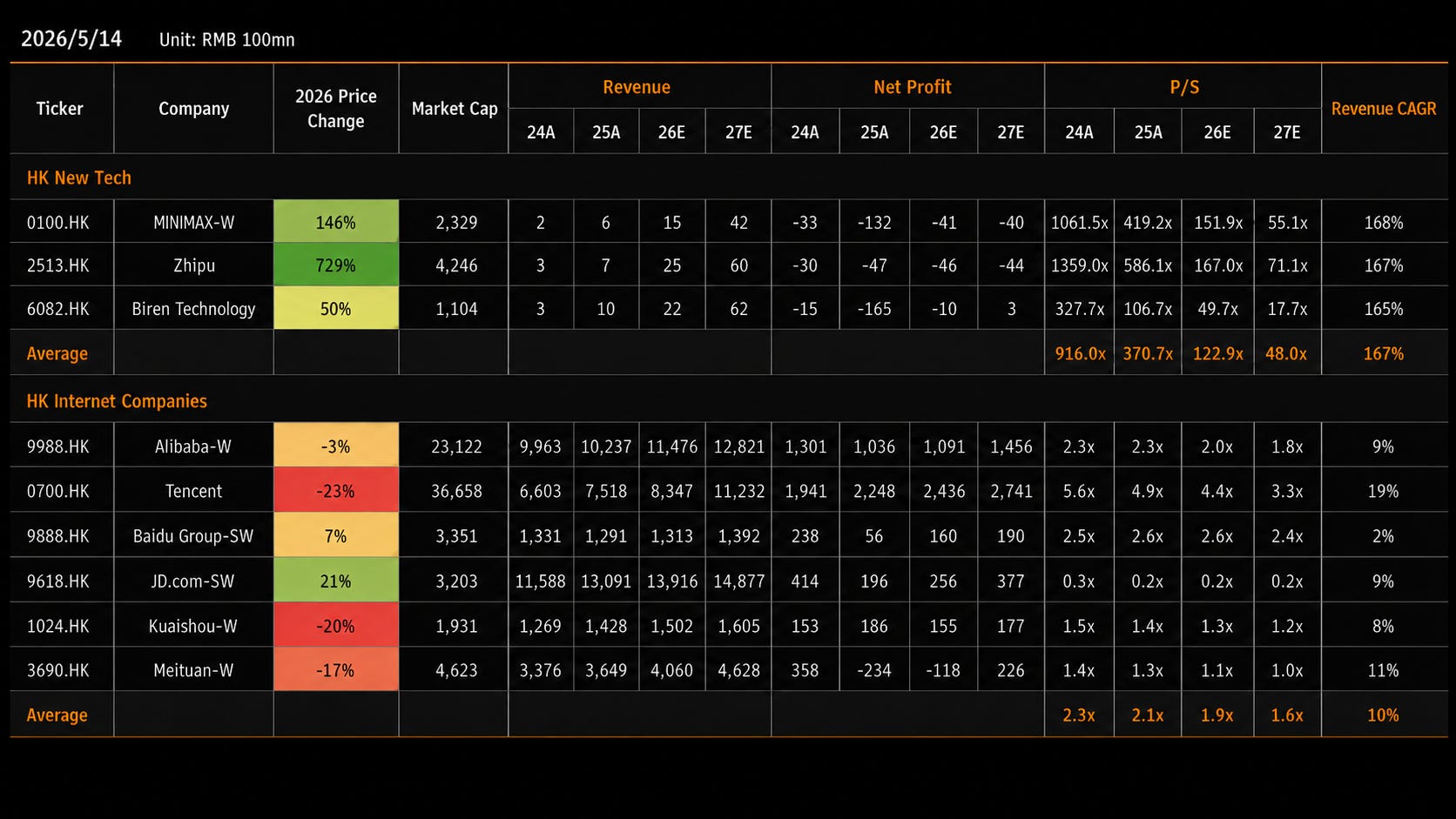
Kuaishou’s own listed market cap is around RMB 195 billion (about $27 billion). Goldman Sachs earlier this year modeled the stock as pricing Kling at only $5 billion. The private-market $20 billion is a 4x re-rating of that piece. Kuaishou itself sits at roughly 1.3x on 2026 revenue estimates, while Hong Kong is paying 100 to 200x for AI labs at the top of the stack and pricing the cash-flow platforms underneath like utilities.
VoC Insights: Aaron Zhou, CIO of a US dollar family office and co-host of the Voice of Context podcast, reads the Kling price against global comps. “Runway raised at a $5.3 billion valuation on $300 million-plus ARR, roughly a mid-to-high teens multiple. Palantir is the only US large-cap above 50x PS, near 60x today. Hong Kong is paying 150x-plus for AI labs like MiniMax and Zhipu. 40x on Kling looks rich globally but cheap inside Hong Kong, and that’s the only number that matters for this deal.”
MiniMax went public in Hong Kong on January 9 and now trades at a market cap of about RMB 230 billion (around $32 billion), implying a PS multiple near 420x on 2025 revenue and 152x on 2026 estimates. Zhipu listed January 8 and is up 729% year-to-date, with a market cap of roughly RMB 425 billion (around HK$465 billion) and a 2026 forward PS near 167x. Kling at 40x forward ARR is by a wide margin the cheapest AI listing in Hong Kong’s 2026 cycle.
From an $11 Billion Market Darling to a Sub-$300 Million Takeover Target, GoPro Explores a Sale
GoPro is for sale. Its market cap sits around $300 million today. The peak was $13 billion a decade ago, when the company held roughly 75% of the global action camera market.
Insta360 overtook GoPro in revenue in H1 2024 by competing at the premium end. DJI launched Osmo Action and used price cuts to attack the entry level. In October 2025, DJI cut prices across multiple product lines by 30%. OPPO and vivo announced 2026 entries into handheld cameras. GoPro’s bookings and gross margin fell together. By Q1 2026, management was filing going-concern language.
VoC Insights: Analysts from Morning Brew of ShengFM (声动早咖啡, our daily Chinese tech and business news show), has tracked GoPro’s missteps since 2024 and identified two decisions inside the company that compounded the share loss. The company spent years stacking SKUs of its single Hero camera at different price tiers, instead of building a second product line. Hero4 Session launched at $399 and ended at $199 after two cuts. GoPro did not ship phone-native video editing until acquiring two editing apps in 2016. Insta360’s founder later said his team built its software stack around exactly that gap.
Segway sold itself to China’s Ninebot in 2015 after Xiaomi-backed competitors crushed its US sales. iRobot attempted to sell to Amazon for $1.7 billion in 2022 after Roborock and other Chinese vacuum brands took most of the global market. That deal collapsed in early 2024 on EU antitrust pushback. GoPro covered the same arc in a decade. The board’s strategic review will likely draw buyers from Chinese hardware companies as well as US defense and aerospace operators where rugged-camera applications and a US-listed brand asset still command a premium.
Unitree Puts a $574,000 Rideable Mecha on Sale After Japan, US, and Canada Only Built Prototypes
On May 12, Unitree released GD01, which the company says is the world’s first mass-produced rideable mecha. The starting price is RMB 3.9 million (about $574,000). The machine carries a pilot in a chest-mounted cockpit, switches between bipedal and four-legged modes in seconds, weighs 500 kg with the pilot on board, and is classified as a civilian vehicle. The launch demo shows the machine punching through a brick wall.
Comparable rideable mecha projects in Japan (Kuratas), the US (MegaBots) all built prototypes over the past decade. None of them put a unit on sale. Unitree’s published price and order page make GD01 the first.
VoC Insights: Diane Ding, co-host of the Voice of Context podcast, just talked to UBTECH Robotics. UBTECH is the first humanoid robot company to go public in China, and the team will tell you they were the first to put a humanoid on the Spring Festival Gala stage. The business has been mostly B2B, so consumers don’t really know the name. They think Unitree’s marketing has outrun its product. UBTECH will ship a humanoid with silicone skin and lifelike micro-expressions, built for the consumer companion robot market. The company wants to make a name for itself with consumers.
Also This Week
Alibaba’s Q1 AI products revenue hit RMB 8.97 billion (about $1.24 billion), the 11th consecutive quarter of triple-digit year-on-year growth. Management guided AI ARR to top RMB 10 billion next quarter and RMB 30 billion by year-end.
Tencent’s Q1 revenue grew 9% to RMB 196.5 billion, with net income up 21%. R&D spending climbed to RMB 22.5 billion on AI rollouts. Shares are down 26% from year-to-date highs despite the beat.
Baidu released Ernie 5.1, using a “multi-dimensional elastic pretraining” technique to hit leading benchmark scores at roughly 6% of comparable-size models’ pretraining cost. It now ranks #1 among Chinese models on LMArena’s search board.
ByteDance’s Doubao launched paid subscriptions at RMB 68, 200, and 500 per month. With 345 million MAU, it is China’s largest AI app. Free competitors Qwen and DeepSeek did not follow.
Junyang Lin, Alibaba’s former Qwen lead, is raising at a $2 billion valuation for a new startup focused on world models and embodied AI. Sequoia China and Gaorong are among the investors in talks.
Pinduoduo committed RMB 100 billion to “New Pinmu”, a private-label arm of Temu targeting the US and EU in apparel, home goods, and outdoor categories. First-phase cash injection is RMB 15 billion, with around 100 staff today.
Xpeng is in talks with Volkswagen to buy a European factory as its contract line at Magna Steyr in Austria runs out of capacity. VW invested $700 million for a 5% stake in Xpeng in 2023 and is cutting 750,000 units of European capacity through 2030.
VoC Weekly covers China’s technology and AI industry for global investors and operators. Share this with someone who’d find it useful. New here?
.