

OpenClaw Went Mainstream, MiniMax Overtook Baidu, and Alibaba's Top Model Builder Walked Out

OpenClaw deployed to nearly 1,000 walk-in users in a single day at Tencent’s Shenzhen headquarters. MiniMax stock hit HK$1,286 intraday, up 680% from its IPO price two months ago, before pulling back as the frenzy cooled.
OpenClaw Is Going Mainstream in China. MiniMax Rode the Wave Past Baidu.
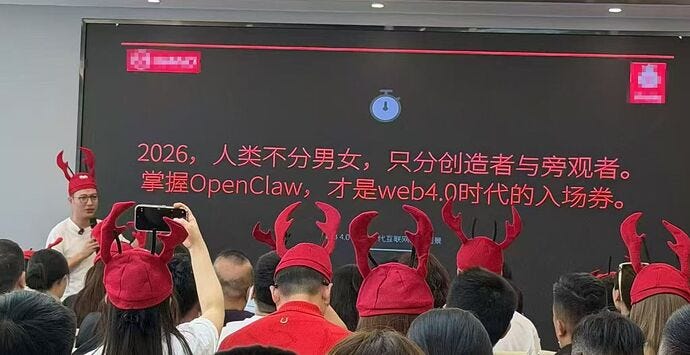
On Douyin and Xiaohongshu, tutorials and paid installation services charging RMB 500 to 1,000 have flooded feeds. On the streets, people are lining up. One outlet called it “the most cyberpunk scene of 2026.”
Tencent has moved the most aggressively. On March 6, Tencent Cloud set up outdoor booths at its Shenzhen headquarters and deployed OpenClaw for nearly 1,000 walk-in users in a single day. It released QClaw, a desktop client that lets non-technical users run OpenClaw locally with one click. On March 9, it launched WorkBuddy, a multi-agent desktop workspace with 20+ built-in productivity skills. Most notably, Tencent opened MCP integration with WeChat Work and QQ, allowing users to control agents directly from chat windows they already use every day.
ByteDance’s Volcano Engine ran livestreamed deployment guides. Feishu raised its free API call limit 100x, from 10,000 to 1 million per month, and launched an official OpenClaw plugin. Alibaba Cloud open-sourced CoPaw, its own desktop agent built to compete with OpenClaw directly.
VoC Insights: Wang Junyu, co-founder of Wandoujia (one of China’s earliest Android app stores) told VoC Weekly that the deployment craze misses the real problem. “How to use it is a much harder question than how to set it up. Installation is already easy. But what do you actually do with it every day? That requires you to understand and abstract your own needs. The barrier is not technical. It is classical product manager thinking.” Wang argued that cloud vendors wrapping OpenClaw in one-click installers are “riding the hype” without adding real innovation. The deeper shift, he said, is that using an open-ended agent demands a skill that used to belong only to corporate managers: the ability to teach someone else how to do things your way. “In the past, only managers needed this. In the future, everyone will.”
On March 10, MiniMax shares surged 22% to HK$1,220, pushing the market cap to HK$382.6 billion and overtaking Baidu, JD.com, Trip.com, and Kuaishou. The stock touched HK$1,286 intraday, up roughly 680% from its HK$165 IPO price in January. But by March 12, shares had pulled back to around HK$1,180 as the initial frenzy cooled and investors took profits.
For cloud providers that collectively spent over $60 billion on capex in 2026, the incentive is clear: every deployment is a token consumption engine pointed at their API endpoints. The wave has reached local government. Districts in Shenzhen, Hangzhou, and Hefei have rolled out subsidy packages, known locally as shí tiáo (“ten articles”), to accelerate adoption of OpenClaw-style AI agents. China’s 2026 Government Work Report mentioned “intelligent agents” for the first time.
VoC Insights: Aaron Zhou, co-host of the Voice of Context podcast and CIO of a Hong Kong-based family office, said Hong Kong AI stocks are developing their own valuation logic. “Investors know OpenAI is good. But some of them simply cannot buy it. So they buy what is available.“ The capital driving MiniMax’s rally, Zhou said, is predominantly Hong Kong-based: a mix of mainland money flowing south and foreign capital parked locally. Global allocation funds have not entered because MiniMax’s free float is still too small. “If MiniMax’s next benchmark scores collapse, or if a major US AI IPO prices badly and drags sentiment, that would hurt. But if a US AI company lists at a strong valuation, that is actually a positive catalyst for Hong Kong AI stocks.”
Alibaba’s Top Model Builder Quit. Then Alibaba Reversed the Restructuring That Drove Him Out.
Two days after Elon Musk praised Alibaba’s Qwen model as “amazing,” the model’s technical leader Lin Junyang quit. The trigger was organizational. On March 3, Alibaba Cloud CTO Zhou Jingren told Lin that Qwen’s roughly 100-person team would be split into horizontal teams and folded into other groups inside Tongyi Lab(Alibaba’s AI lab). Lin also learned for the first time that Hao Zhou, a former Google DeepMind senior staff researcher, had quietly joined Alibaba in January to take over post-training. Lin resigned that afternoon.
VoC Channel Check: An Alibaba spokesperson told VoC that the company has not changed Qwen’s open-source strategy and has not imposed DAU or other consumer app metrics on the foundation model team. “As Qwen was elevated from a base model project to a group-level strategic priority, the company decided to bring in more top-tier technical talent to raise the density of the foundation model team. That process involved adjustments to Lin Junyang’s scope of responsibility. He did not accept the changes and chose to resign.”
On March 9, Alibaba announced interim management. Zhou Jingren will personally oversee Qwen’s model development as acting technical lead. Liu Dayiheng, who has led pre-training since the team’s early days, will also take charge of post-training and coding. The core research modules remain grouped together rather than split horizontally, a signal that Alibaba pulled back from the restructuring plan that prompted Lin’s departure.
The restructuring exposed a fault line that had been building for months. With just over 100 researchers, the team open-sourced over 400 models since 2023, accumulated 600 million+ downloads, and spawned 170,000+ derivative models on Hugging Face, surpassing Meta’s Llama. That community trust was inseparable from Lin’s personal engagement: he answered developer questions on GitHub and promoted new releases at midnight.
But Alibaba wanted more than open-source credibility. It launched a consumer AI app that reached 203 million MAU after a billion-yuan Lunar New Year spending blitz. A senior Alibaba executive called the Qwen 3.5 Plus model released on Lunar New Year’s Eve a “semi-finished product.” For the company, technical influence and open-source downloads were means to commercial ends. For the Qwen team, they were the whole point.
VoC Insights: A current Qwen team member, who is also preparing to leave, offered a blunter account. The team was rattled a month ago when ByteDance’s Seedance went viral, triggering what staff internally call the “token campaign,” a push to hit aggressive token-consumption targets that extended KPI pressure to the research team. “What I care about is model quality, and the conditions for that are getting worse.“ The member added that Alibaba’s AI lab sitting underneath the Cloud division creates structural problems. “The brand itself has become a liability.”
The talent fallout was immediate. Several key researchers announced departures on the same day. Google DeepMind’s developer experience lead publicly invited Qwen members to join on X. Investors started seeking introductions, betting on startup launches. One investor called Lin “at least a $100 million-level talent.”
VoC Insights: Zhou Vivi, Chief People Officer of Maimai (China’s LinkedIn equivalent), told VoC Weekly that Lin represents a category of talent that barely exists on the open market. “It’s full-throttle competition right now and there are only so many people at his level. Someone like Junyang is better suited for founding his own startup or getting recruited to Silicon Valley.”
We Tested Meituan’s New AI Browser Agent. It Got Stuck on the Wrong LinkedIn Profile.
Meituan released Tabbit, a free AI-native browser, into public beta on March 2. The product comes from Light Years Beyond, the AI startup founded by Meituan co-founder Wang Huiwen and acquired by Meituan for RMB 2.07 billion in 2023. Within 24 hours, developers discovered that Tabbit’s translation feature used code from Read Frog, an independent open-source project, without proper attribution. The two sides later issued a joint statement confirming the matter was resolved.
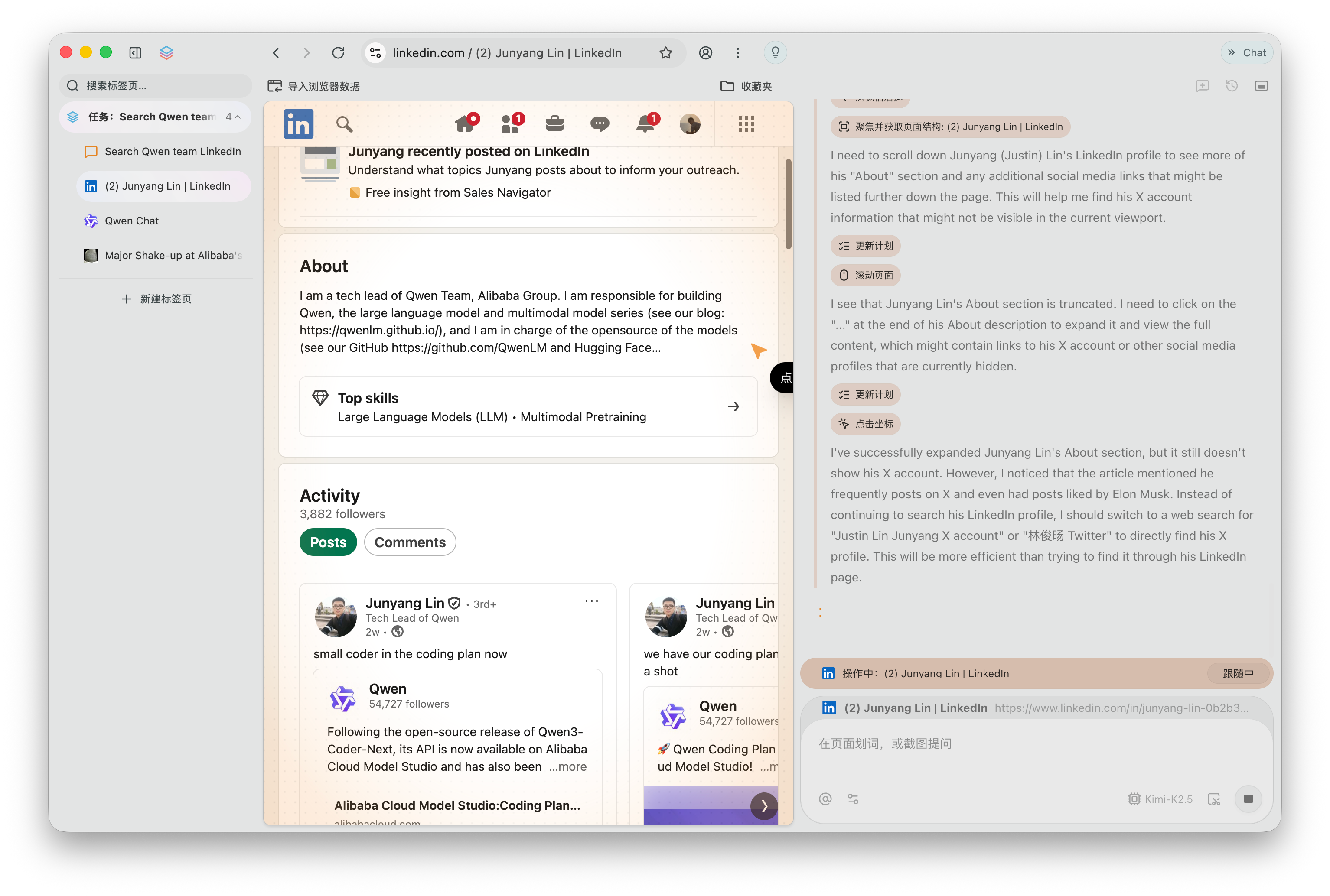
VoC Channel Check: VoC Weekly tested Tabbit’s agent mode with a real-world task: “Search LinkedIn for members of the Qwen team, then find their corresponding X accounts, and compile everything into a table and export it to Excel.” The agent opened LinkedIn correctly, but immediately misinterpreted the query. Instead of searching for Alibaba’s Qwen AI team, it navigated to a LinkedIn profile belonging to a person named “Qwen” and spent over ten minutes stuck on the wrong page before recognizing the error. It never completed the full task.
VoC Weekly covers China’s technology and AI industry for global investors and operators. Share this with someone who’d find it useful. New here?